A research project in collaboration between HURACT and Università Cattolica del Sacro Cuore, Milan.
Introduction
The Value of Work-Life Balance
Work-Life Balance (WLB) is a crucial factor for individual well-being and organisational health. When present, it supports personal satisfaction, motivation, engagement, and reduces burnout. Recent studies (Nicklin, Seguin & Flaherty, 2019) confirm that a good balance between professional and personal life is a positive predictor of psychological health, productivity, and sustainable workplace relationships.
The most consolidated interventions to promote WLB are so-called "hard" strategies—structural and organizational changes such as flexible schedules, smart working, job rotation, effective leadership, and process management. These strategies are essential but not always feasible.
When "hard" interventions are not possible
In many work settings, the very nature of the job makes structural changes difficult or impossible. Think of teachers, healthcare workers, retail employees, or corporate trainers with rigid agendas and fixed workloads. In these cases, the difficulty in reconciling life and work results not only in operational stress but also in additional emotional strain.
For example, a board meeting scheduled at the same time as picking up a child from school is often not negotiable. This leads to double frustration: being late to both commitments, and experiencing dysfunctional negative emotions such as guilt, regret, anger, and inadequacy.
Can we at least intervene on the cognitive-emotional level?
When structural change is not an option, can we offer individuals tools to manage their inner dialogue? To reduce self-blame, be more compassionate with their limits, and alleviate the emotional weight of frustration?
This question gave rise to our experimental project, which combined evidence-based approaches with advanced technologies like Virtual Reality (VR), Personalized Avatars, and digital learning platforms.
The Research Project
The choice to use advanced technologies such as immersive VR and Personal Avatars aimed to enhance proven interventions through innovative delivery.
We built upon self-compassion-based cognitive-emotional restructuring protocols already supported by evidence, enriched through two technologies: immersive VR to create a pseudo-hypnotic context, and personalised avatars to strengthen the internal dialogue with one's compassionate self.
Experimental Design
The project used a parallel-group experimental design with three measurement times: pre-intervention (T0), post-intervention (T1), and follow-up. Participants were assigned to two groups: an experimental group (who received the intervention) and a control group (placebo intervention). This setup allowed us to evaluate both the effectiveness and sustainability of the intervention.
The Intervention
The experimental protocol involved three sessions. Participants in the experimental group accessed a fully immersive virtual reality environment using VR headsets. Within this environment, each participant interacted with their own Personal Avatar: a realistic 3D model generated from their own image and voice. The avatar guided a short self-compassion session based on mindfulness and acceptance practices, speaking to the user from a caring and supportive stance.
The control group received time management lessons.
The intervention was delivered through the LMS platform huract.online, ensuring easy access to content, self-guided participation, and session tracking.
Our initial hypotheses were that the intervention would have a significant effect on both Self-Compassion and Work-Life Balance, and that this effect would be moderated by the degree of avatar identification ("mirroring"). The higher the mirroring, the greater the expected impact.
Key Results
1. Effectiveness of the intervention
The results confirmed our hypotheses, showing a positive effect of the intervention on both Self-Compassion and Work-Life Balance compared to the control group.
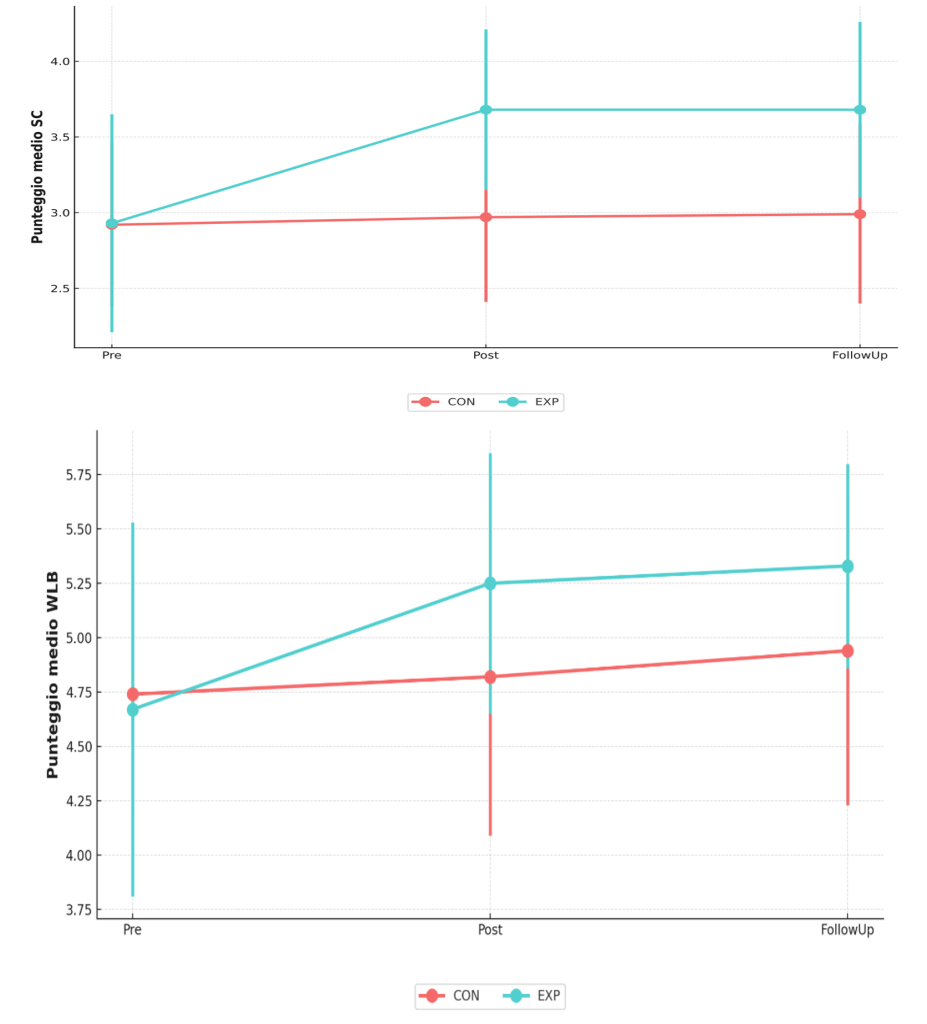
In particular:
- The experimental group showed a significant increase in Self-Compassion compared to the control group.
- Work-Life Balance also improved significantly in the experimental group, especially between T0 and Follow-up.
2. The Role of Avatar Mirroring
Contrary to our expectations, the level of mirroring did not moderate the effectiveness of the intervention and remained relatively stable throughout the sessions.
These findings suggest that even without strong identification with the avatar, the guided experience can still generate measurable positive effects over time.
Conclusions
Preliminary results confirm our main hypothesis: the Self-Compassion intervention delivered via VR and Personal Avatar had a positive effect on participants' Work-Life Balance.
Moreover, its effectiveness was not influenced by the level of avatar mirroring. This is operationally important, as it suggests the intervention works even when individuals do not identify strongly with (or do not particularly like) their avatar.
In addition, the use of LMS platforms for self-guided access makes the intervention highly scalable: organizations only need to provide a suitable space equipped with VR headsets and basic instructions.
In conclusion, while "hard" interventions remain the most effective, when these are not feasible, it is possible to act through "soft" strategies enhanced by innovative technologies like VR and Personal Avatars, delivered via LMS platforms, to improve WLB and employee wellbeing.
These results encourage further studies and applications across different organisational contexts, including at scale.